For years, the story seemed settled.
Humans crossed a land bridge from Siberia.
They moved south.
They populated the Americas.
Simple.
But then archaeologists in Alaska uncovered a burial site that refused to fit the script.
Two Ice Age infants.
11,500 years old.
And DNA that didn’t match the history books.
Suddenly, American prehistory didn’t look so simple anymore.
The Burial That Changed Everything
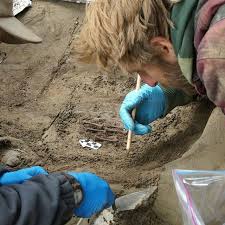
At a remote site known as Upward Sun River near Fairbanks, researchers discovered a carefully prepared grave containing two infants buried beneath red ochre — a ritual pigment often associated with deep cultural meaning.
This wasn’t just another excavation.
The remains were exceptionally preserved.
And preserved remains mean one thing:
Ancient DNA.
When scientists sequenced the genome of one infant — labeled USR1 — they weren’t expecting surprises.
They got one anyway.
The Lineage No One Knew Existed
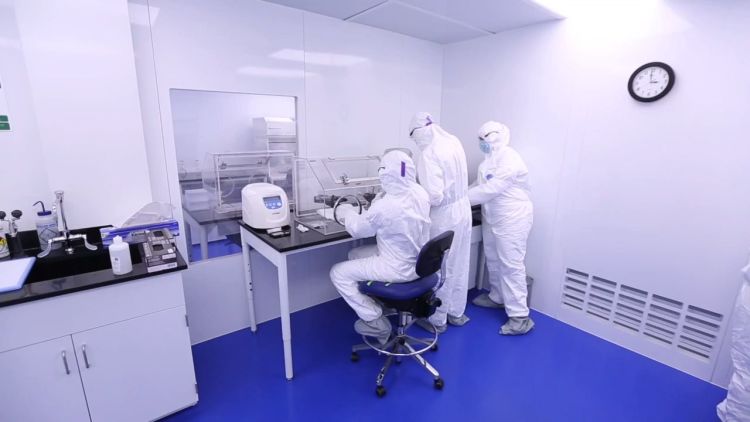
Instead of fitting neatly into known Native American genetic branches, USR1 belonged to something different.
A lineage now referred to as the Ancient Beringians.
This group appears to have split from other Native American ancestors thousands of years earlier than scientists previously believed.
That means:
By 20,000 years ago, humans in the far north weren’t one unified population.
They were already genetically diverging.
And that complicates everything.
Beringia Wasn’t Just a Bridge
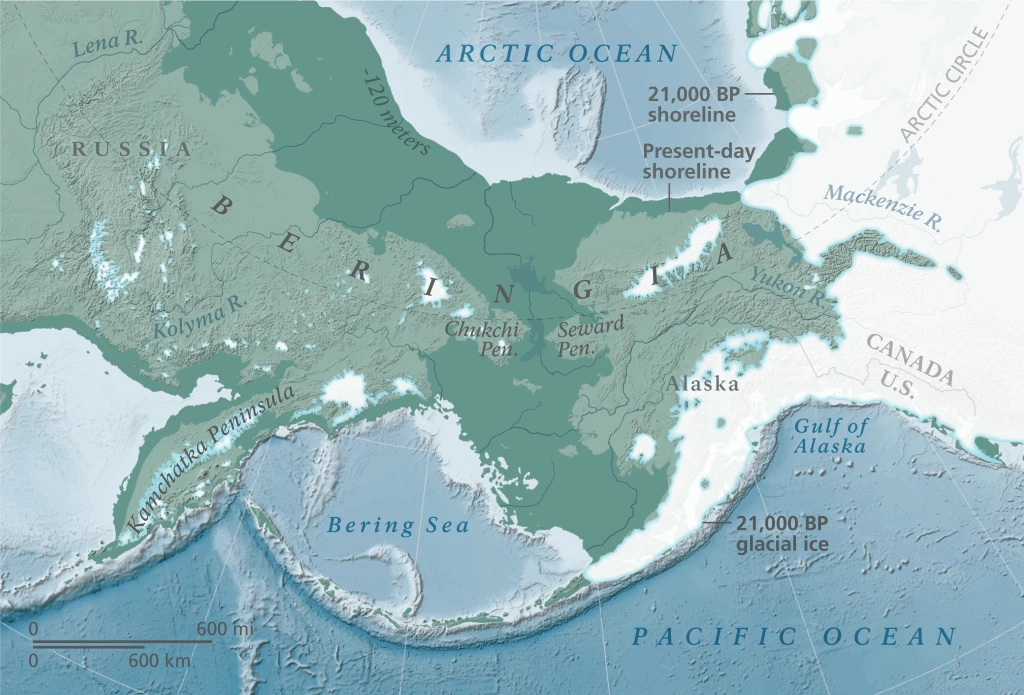
During the last Ice Age, lower sea levels exposed a massive landmass connecting Siberia and Alaska: Beringia.
For decades, it was described as a corridor — a temporary crossing point.
But the DNA suggests something bolder:
Humans may have lived there in isolation for thousands of years.
Not passing through.
Staying.
This supports what’s called the Beringian Standstill Hypothesis — the idea that early populations were stranded (or settled) in Arctic conditions long before spreading south.
If that’s true, the Americas weren’t populated in one clean wave.
They were shaped by splits, pauses, and overlapping migrations.
Even More Complicated Than That
The second infant buried at the same site?
She didn’t share the exact same genetic branch.
Two babies.
One grave.
Two distinct ancestral paths.
That suggests early North America wasn’t home to just one founding population — but several interacting groups.
The tidy timeline just got messy.
What Scientists Still Don’t Know
This discovery answered some questions — and raised even bigger ones.
Here’s what remains uncertain:
1️⃣ What Happened to the Ancient Beringians?
There is no clear, separate Ancient Beringian population today.
Did they disappear?
Were they absorbed into later groups?
Were they replaced?
Most researchers suspect gradual integration — but there’s no definitive answer.
2️⃣ How Early Did Humans Arrive?
Some archaeological sites suggest humans may have been in the Americas earlier than 13,000 years ago.
Monte Verde in Chile.
Bluefish Caves in Canada.
If Ancient Beringians had already split genetically by 20,000 years ago, then human presence in the north may go back even further.
That pushes timelines into uncomfortable territory for older migration models.
3️⃣ Were There More Lost Lineages?
Ancient DNA is still a young field.
For decades, scientists relied on stone tools and settlement patterns.
Now they’re reading genomes.
And every new genome has the potential to reveal another forgotten branch of humanity.
If one unknown lineage existed, it’s possible others did too.
Why This Matters
This isn’t about undermining Native American history.
In fact, it highlights just how deep and complex that history truly is.
What’s being rewritten isn’t identity.
It’s the migration map.
Instead of:
Asia → America → Southward Expansion
We may be looking at:
Asia → Arctic Isolation → Multiple Splits → Overlapping Waves
And that’s a far more dynamic story.
It’s part of an expanding scientific revolution.
What Comes Next?
Researchers continue sequencing ancient genomes across:
• Alaska
• Siberia
• Canada
• South America
Each new sample adds another puzzle piece.
And sometimes — like this one — it forces historians to redraw the entire board.
Prehistory isn’t static.
It’s being rewritten in real time.
readalso]
Why Were Historians Turned Pale When They Zoomed In On This 1887 Wedding Portrait?
The basement archive of the Chicago Historical Museum smelled of old paper and dust — a scent Dr. Rachel Thompson had grown strangely fond of during her fifteen years as a curator. On this quiet October morning in 2024, pale sunlight filtered weakly through the high basement windows, stretching long shadows across rows of storage…
This 1901 Studio Portrait Looks Normal — Until Experts Zoomed In On The Child’s Eyes
The photograph looked ordinary at first. An elegant couple. A small girl sitting quietly between them. A carefully arranged studio portrait from the early 1900s. For decades, it sat forgotten in an archive box. But when museum researcher Sarah Brennan scanned the image at high resolution, she noticed something that made her stop breathing. The…
Take A Look At These Photos Of Celebrities Hanging Out With Their Younger Selves

There’s something oddly fascinating about seeing celebrities side-by-side with their younger selves. Some of them look almost exactly the same, while others have changed dramatically over the years. From Hollywood legends to pop icons, these photos show just how time — and fame — can transform someone. Let’s take a look. Emma Watson There is…
Tiger Woods’ Ex Turns 42 — Wait Until You See Her Now

At first glance, Tiger Woods and Elin Nordegren looked like the ultimate power couple. He was one of the most famous athletes on the planet.She was the elegant Swedish beauty who seemed to fit perfectly into his world. But behind the polished photos and lavish lifestyle, their marriage was heading toward one of the most…
An Elephant Kept Digging for Hours — Then Villagers Realized Why
Elephants are known for their intelligence, emotional bonds, and powerful instincts. In India, where these animals are deeply respected, one unforgettable event reminded everyone just how strong a mother’s instinct can be. In 2015, during the rainy season in eastern India, something unusual happened. A herd of about 60 elephants was crossing through the region…
Mother of Three Found Alive 24 Years After Disappearance — Here’s What She Said

A woman who disappeared in 2001 has been found alive more than two decades later, closing one of the most emotionally complex missing-person cases in recent memory. Michelle Lynn Handley Smith, a mother of three, vanished in December 2001 after telling her family she was heading out for Christmas shopping. She never returned. For 24…
Top Articles